

An “AI copilot” to improve the production process in the factory.
Explainable Anomaly detection
Train a model to reduce waste and increase productivity.
The Challenge
Predicting production waste in advance
Prima Sole Components S.p.A is a company that produces automotive components through injection molding: parts that require high precision.
Out of approximately 43,000 pieces produced each year, about 600 are discarded, equal to a 1.3% defect rate that generates significant costs and inefficiencies.
We started from one question: can AI explain and predict why 1.3% of the parts turn out defective?
The need brought to light
Optimising waste by listening to data
The manufacturing company shared with us the real data generated by the injection molding process over the last 12 months. We augmented it with synthetic data to improve robustness and analysis accuracy.
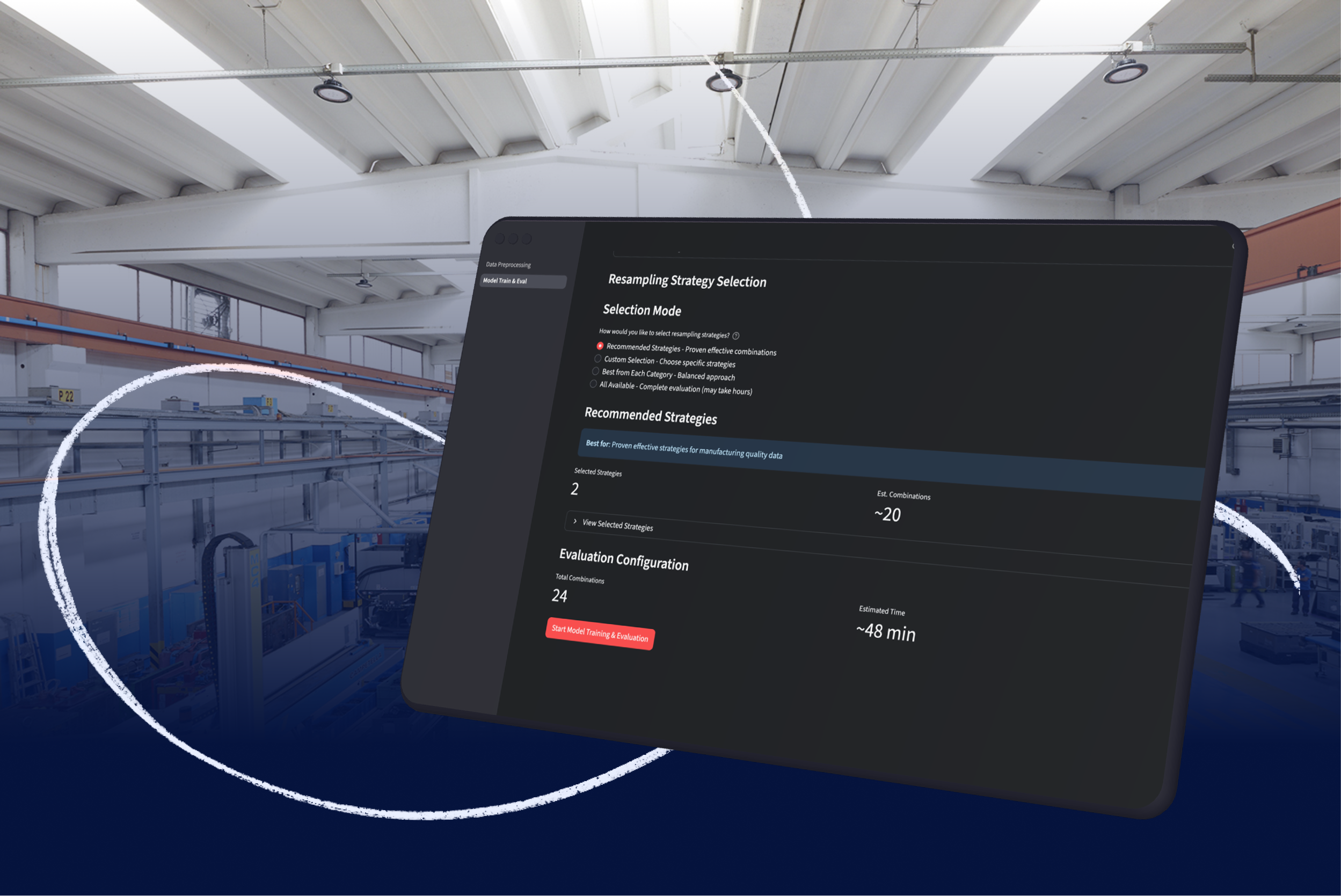
We then tested over 75 Machine Learning algorithms to understand the causes of defects and predict them in advance.
The solution
An AI co-pilot capable of identifying and explaining anomalies
We developed an Explainable Anomaly Detection system that flags potentially defective parts in advance.
It is an accessible interface that provides a precise explanation for every prediction, identifying the parameters (temperature, pressure, timing) contributing to the defect risk.
At the same time, it allows operators to request real-time support and enter production data in a simplified way.
The model continuously trains, becoming a true AI copilot that ensures less waste and more informed decisions.
Towards a smarter industry
In the short term, Prima Sole Components S.p.A. has achieved 75% of its production defect prediction target, with the aim of reaching 99% thanks to data enrichment and model training in the medium to long term.
Do you have a similar challenge?
“We are confident that a project like this will allow us to improve our competitiveness. […] Thanks to the team that worked on it and to our colleagues who showed commitment and trust. In the industrial production world, it is not easy to explain what artificial intelligence means because we are used to traditional methods. I hope that, at the right time, we will be able to extend this model to all our plants.”
Marco Micheli
BU Administrator @Prima Components Italy